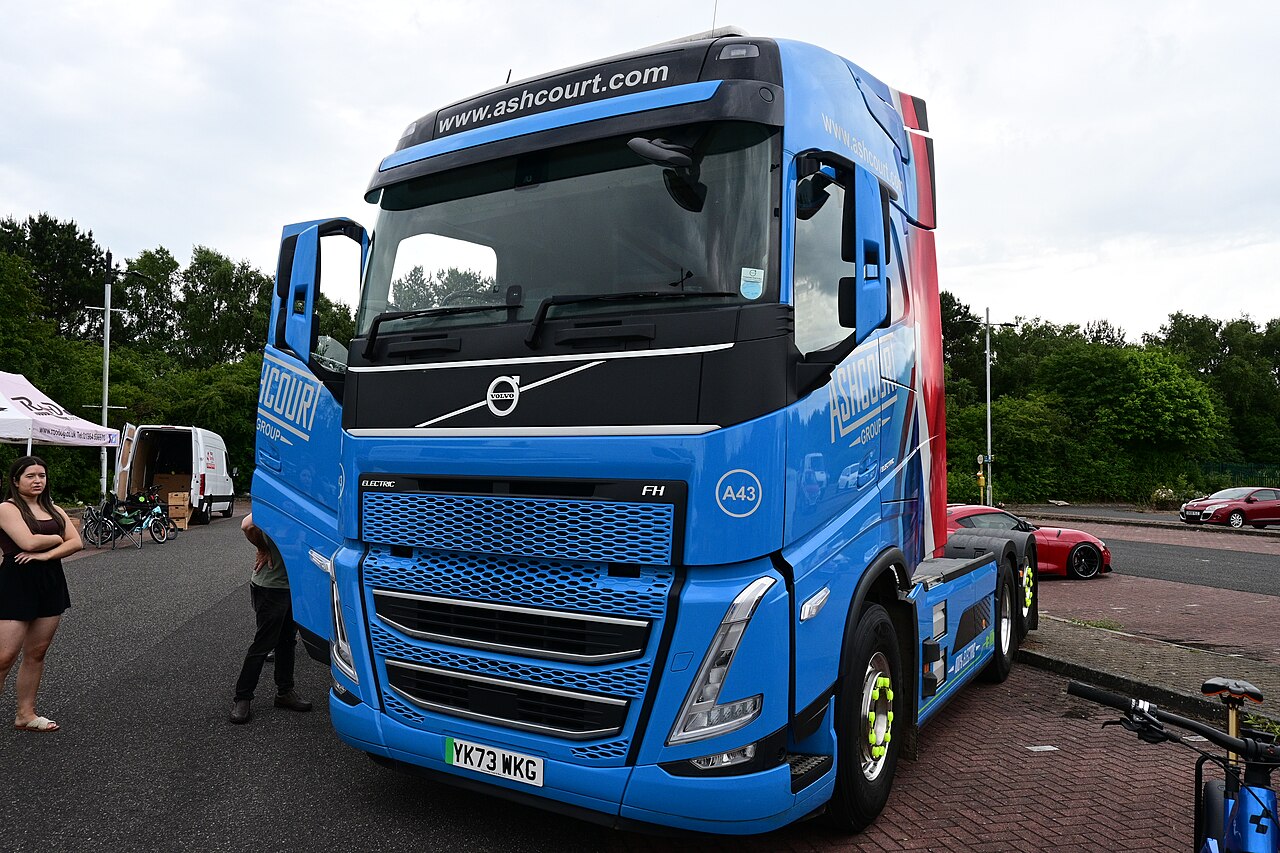
Volvo Trucks announced on 14 September 2026 a new electric truck rated for gross combination weights of up to 80 tonnes — a segment of heavy haulage that, until now, electric drivetrains simply couldn't reach without a crippling range penalty. The new truck delivers up to 450 kilometres at 64 tonnes and 420 kilometres at 74–76 tonnes, on an 8-speed transmission built specifically for electric motors and hub-reduction axles for better ground clearance and startability on loaded grades.
This is not a rebadge of the FH Aero Electric long-hauler Volvo launched in April, which tops out around 44 tonnes and 700 kilometres in its lightest configuration. It's a separate product aimed squarely at the weight class that has kept European heavy-truck electrification stuck at the margins: timber, construction aggregate, tank and bulk haulage, where payload, not range, has been the binding constraint.
Why 80 Tonnes Is the Number That Matters
Battery electric trucks have made real progress on range over the past two years. What they have not solved, until this announcement, is the trade-off between battery mass and payload at the top of the legal weight scale.
Add enough battery to hit 700 km of range and you eat into the tonnage a truck is allowed to carry — a serious problem in a segment sold on cost-per-tonne-kilometre. Volvo's answer is not to chase maximum range at any weight. It's to size the battery — 640 kWh usable — to hold a genuinely useful range at 80 tonnes, rather than sacrificing gross weight to protect a headline range number.
"High total weights in truck transport lower both transport costs and environmental impact. If we also electrify these transports, we take an important step toward more sustainable transport," said Jan Hjelmgren, Volvo Trucks' SVP of Product Management.
That is the commercial logic in one sentence: heavy-haul operators don't buy range, they buy tonnes moved per charge. A 420 km truck that can legally carry 76 tonnes is worth more to a Nordic timber hauler than a 700 km truck that can't.
The Charging Numbers
- Megawatt Charging System (MCS): 20–80% in roughly 36 minutes at up to 680 kW
- CCS2 (standard combined charging): 20–80% in roughly 70 minutes at up to 360 kW
- Electric power take-off (e-PTO): for refrigeration units and other auxiliary equipment without idling a combustion engine
- Cold-climate hardware upgrades: improved battery insulation and updated battery monitoring, aimed squarely at the Nordic and Alpine markets where this truck launches first
The MCS figure is the one worth sitting with. A sub-40-minute charge to 80% on an 80-tonne truck compresses the operational gap between diesel and electric almost to the point of irrelevance for regional and even some long-haul duty cycles — provided the megawatt charging infrastructure exists to deliver it, which today, outside a handful of pilot corridors, it largely doesn't.
Where It Launches, and Where It Doesn't — Yet
Sales begin in early 2027, and the initial market list is telling: Sweden, Norway, Finland, Denmark, the Netherlands and Switzerland. Six countries, all with dense fast-charging networks, favourable carbon pricing on freight, and — not coincidentally — some of the highest diesel-to-electric total-cost-of-ownership parity in the world for heavy trucks.
Notably absent from the initial rollout: Germany, France, the UK, and anywhere in North America. That is not a technical limitation of the truck. It's an infrastructure and incentive gap. Megawatt charging corridors capable of supporting an 80-tonne electric fleet at scale exist almost nowhere outside Scandinavia and parts of the Alpine region today.
How This Reads Against Tesla
Passion4Drive covered Tesla's Semi rollout event at its dedicated Nevada Gigafactory earlier this month — a 1.7-million-square-foot facility built around a single 500-mile-range Class 8 truck aimed primarily at the US market. Volvo's approach is close to the inverse: rather than one flagship spec chasing a headline range figure, Volvo is now running two distinct electric truck platforms — the FH Aero Electric for long-haul range, and this new 80-tonne variant for maximum legal weight — sold into markets where the charging infrastructure to support them already exists.
Both companies are converging on the same conclusion from opposite directions: there is no single electric truck spec that serves both long-haul range and maximum-tonnage haulage. The industry is starting to segment its electric offerings the way it long ago segmented its diesel ones — by duty cycle, not by a single spec sheet.
What to Watch Next
- Early 2027 order books in the six launch markets, and whether Volvo's own dealer network reports meaningful pre-orders from timber, construction and bulk-haulage fleets
- Megawatt charging corridor build-out beyond Scandinavia — the truck's 36-minute charge time is only as useful as the infrastructure that can deliver 680 kW
- Whether Germany or France get added to the market list before general availability, which would signal Volvo sees demand extending beyond the Nordic pilot markets
- Daimler and Scania's response — both have heavy-duty electric trucks in development, and an 80-tonne, sub-40-minute-charge competitor from Volvo raises the bar for what "heavy-duty electric" has to mean going forward
Electric trucking's next constraint isn't battery chemistry. It's whether the grid and the charging corridors can keep pace with trucks that can now legally carry everything a diesel could.