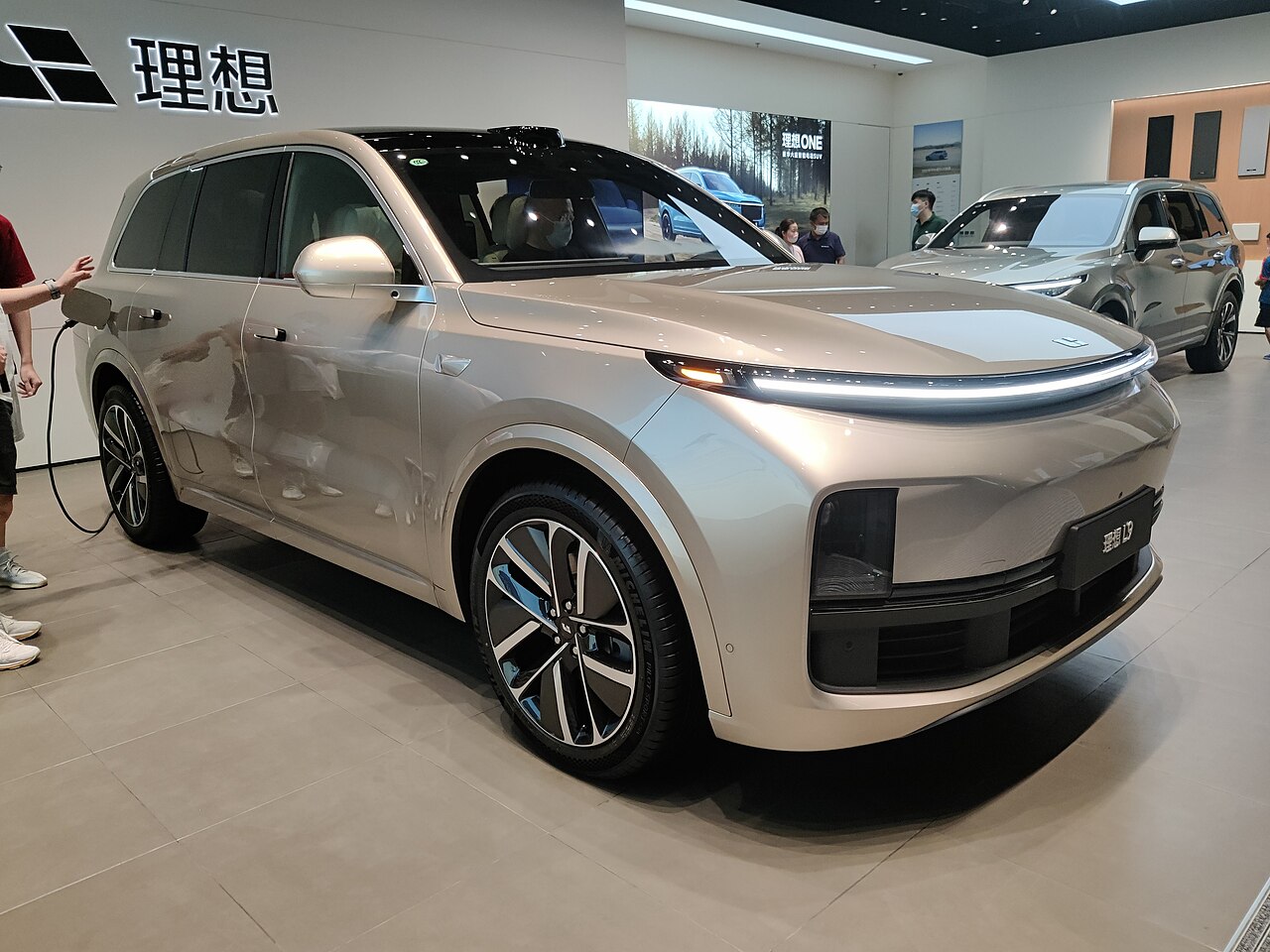
Li Auto launched the Li i9 on 16 September 2026, a six-seat battery-electric flagship priced at RMB 369,800 — roughly US$55,100 — in a single configuration, with deliveries starting the same week.
Two things about that sentence are unusual, and both are deliberate.
One Price, One Car
There is no trim ladder. No long-range variant, no performance variant, no stripped-out entry price engineered for the headline. Li Auto put one specification on sale and attached one number to it.
That is a confident move in a market where the standard Chinese playbook is a four-rung price ladder designed to advertise from the bottom and sell from the middle. It also removes the most common source of buyer friction in the segment — the fear of having chosen the wrong rung — and it simplifies production planning considerably when you are ramping a new flagship.
The only meaningful option is compute: the Mach M100 chip is standard, with a dual-chip package available for a further RMB 30,000.
The Price Sits Below Expectation, Not Above It
Here is the detail that matters commercially. The i9 lands RMB 30,000 above the i8 AWD at RMB 339,800 — a premium of roughly 8.8% for a car that is 140 mm longer, rides on a 118 mm longer wheelbase, and carries two more seats' worth of usable packaging.
Flagships usually cost considerably more than that relative to the model beneath them. Li Auto has priced the i9 as an extension of its range rather than a crown on top of it.
And the i9 does not win the specification war within its own showroom. Its 705 km CLTC range is lower than the i8's 720–780 km. A buyer moving up is explicitly trading range for space.
The i9 is not the longest-range car Li Auto sells, and it was never meant to be. It is the roomiest — and in this segment, that is the specification customers actually shop on.
What the Hardware Actually Delivers
The mechanical package is strong without being ostentatious:
- 101 kWh ternary lithium battery with 5C charging — Li Auto claims 500 km of range added in 10 minutes
- Dual-motor AWD, 400 kW (536 hp) and 660 Nm, 0–100 km/h in 4.9 seconds
- 5,225 mm long, 1,970 mm wide, 1,752 mm tall, 3,168 mm wheelbase
- Steer-by-wire with rear-wheel steering, giving a 10.6 m minimum turning diameter
- A claimed drag coefficient of 0.215, which Li Auto states makes it the most aerodynamic mass-production SUV in the world
That turning circle deserves a second look. A 5.2-metre SUV that turns inside the radius of a compact hatchback is a genuine engineering answer to the real objection large SUVs face in Chinese cities — multi-storey car parks and single-lane residential lanes.
The Interior Is the Product
The cabin is where Li Auto has concentrated the spend, and the specification reads less like a car and more like a room:
- Six seats with power-swivelling second-row chairs that rotate to face the third row
- Four zero-gravity seats that deploy simultaneously
- A 29-inch 6K front panoramic display and a 21-inch 4K rear entertainment screen
- A 9.3.6-channel audio system rated at 4,960 W peak
- A 10-litre refrigerator
- Qualcomm Snapdragon 8797 processing behind the infotainment
Swivelling second-row seats and a fold-out table turn the middle of the car into a face-to-face space. This is the "family SUV" brief taken literally — a vehicle configured for what happens when it is parked as much as for how it drives.
Why It Matters
Li Auto built its business on extended-range electric vehicles and has spent the last two years proving it can sell pure battery vehicles at premium prices. The i9 is the test of whether it can do that at the top of the range, where NIO's ES8 and the AITO M9 already have established positions and where brand equity, not specification, usually decides the outcome.
Three things are worth watching over the next quarter:
- Order conversion versus the MEGA. Li Auto's first pure-electric flagship attempt did not land as planned. The i9 is the second swing at the same customer, with a far more conventional body shape — which was widely read as the MEGA's problem.
- Whether the single-configuration strategy holds. If Li Auto adds a cheaper variant within six months, the launch price was a positioning exercise rather than a pricing decision.
- Cannibalisation of the i8. An RMB 30,000 gap is small enough that the i9 may pull buyers up rather than bring new ones in. Higher average selling price is good; a shrinking i8 order book is not.
The plain version: Li Auto has built a very large, very fast, very well-equipped electric room on wheels, priced it with unusual restraint, and bet that Chinese premium-SUV buyers care more about the second row than about the last 75 kilometres of range. On the evidence of this segment so far, that is the right bet.