Nissan's chairman for the Americas, Christian Meunier, said the quiet part out loud on 21 September 2026: the company has no more room in its American factories.
"We're now maxing out the production capacity in the U.S. The next step is going to be three shifts."
It is an unusual sentence to hear from Nissan. For most of the last five years the company's problem has been the opposite one — too much capacity, too few buyers, plants running warm rather than hot. The 2027 Rogue, and specifically its hybrid variant, has inverted that in a single product cycle.
What Is Actually Constrained
Nissan builds cars in the United States at two plants, and both are already on two shifts.
- Smyrna, Tennessee — roughly six million square feet, building the Rogue, Pathfinder, Murano and Infiniti QX60
- Canton, Mississippi — roughly 4.7 million square feet, around 3,200 employees and about 410,000 units of annual capacity, building the Altima and Frontier
Together they produced approximately 487,000 vehicles in 2025. Adding a third shift at both sites would take that to roughly one million a year — a near-doubling achieved without pouring concrete.
That last point is the whole reason this is a story. A third shift is a labour and logistics decision, not a capital one. It can be reversed. It does not require a plant announcement, a groundbreaking or a state incentive package. It is the cheapest capacity a manufacturer can buy, and it is available in months rather than years.
It has not been approved. Meunier described it as the next step, not a committed plan, and Nissan has not announced hiring numbers, a timeline or a decision date. Treat it as stated intent with the economics attached.
The Tariff Arithmetic Underneath
The strategic logic here is not really about demand. It is about where the cars are assembled.
Nissan has moved Rogue, Pathfinder and Frontier production into US plants, and by Motor1's accounting that shift has avoided roughly $2.3 billion in tariff exposure. The first-half 2026 numbers show the machine working:
- US production up 24.2% to 303,677 units
- US sales up 0.3% to 489,809 units
- Global sales down 6.7% to 1,506,052 units
- Global production down 6.8%
Read those four lines together and the picture is unambiguous. Nissan is not growing. Nissan is relocating — pulling volume out of a shrinking global system and concentrating it in the one market where local assembly converts directly into margin that would otherwise have gone to a customs authority.
North America already accounts for just over 40% of Nissan's global sales. The company has said it wants 80% of its US-sold vehicles built domestically by 2030. A third shift is how you get there without a new factory.
The Rogue Hybrid Is the Product Doing the Work
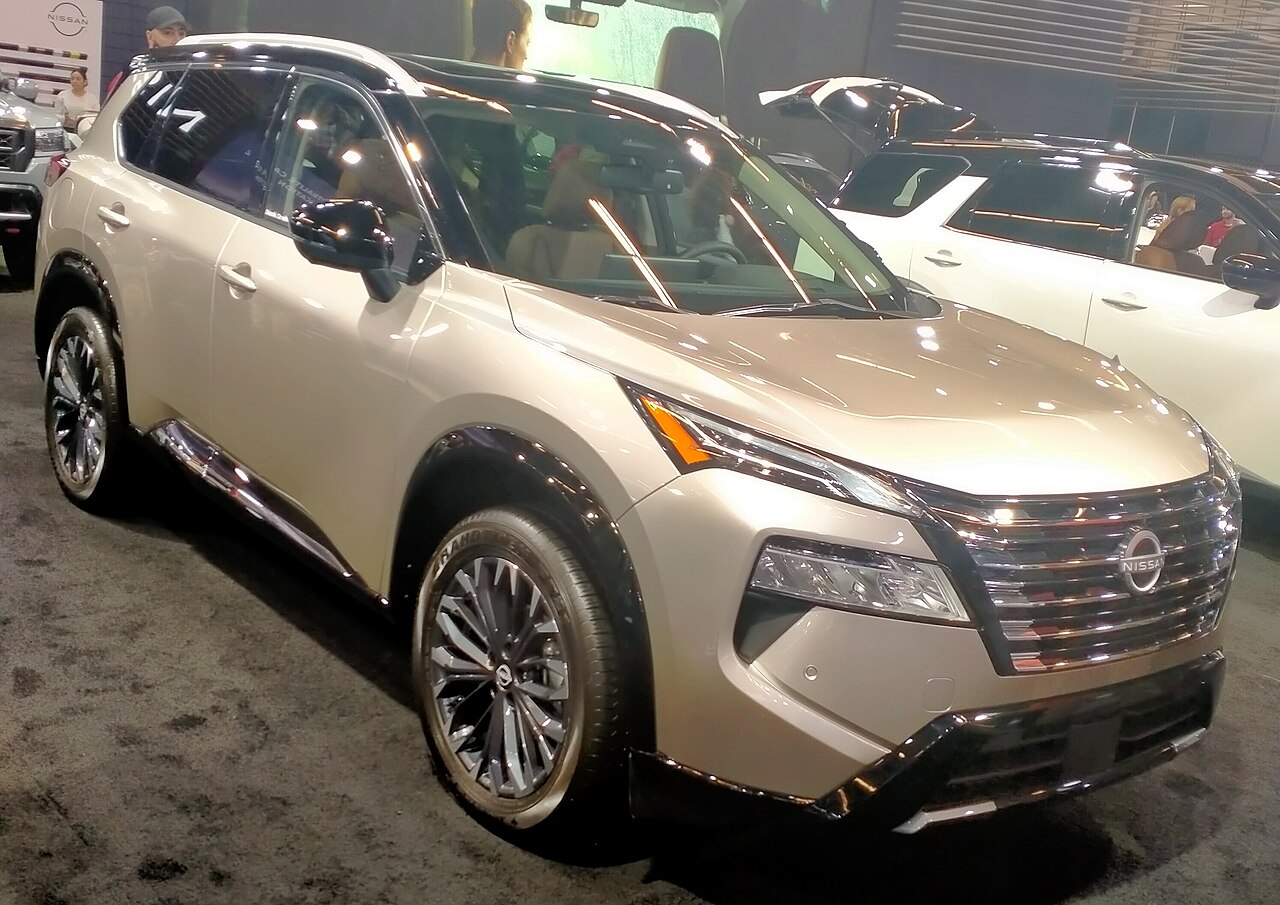
The 2027 Rogue arrives with an e-Power hybrid variant, and the architecture matters more than the badge.
In e-Power, the 1.5-litre petrol engine never drives the wheels. It runs as a generator; electric motors provide all propulsion; there is no plug and no charging behaviour to learn. For an American buyer who wants electric drive characteristics without a home charger or a public-network relationship, it removes the two objections that stall most EV purchases.
Pricing runs from $35,490 for the SV grade to $43,490 for the Platinum, plus $1,575 destination — squarely inside the compact-crossover fight rather than above it.
The timing, though, contains the awkward part. US production of the new Rogue begins at Smyrna in spring 2027. The hybrid versions will initially be imported from Japan, with domestic hybrid build following later.
Nissan is about to import the exact product it is using to justify domestic expansion. The tariff logic and the launch calendar are, for a while, pointing in opposite directions.
Why It Matters
Three things are worth tracking from here.
- A third shift is a commitment to the tariff regime persisting. You do not staff a third shift to dodge a trade policy you expect to lapse. If Nissan approves it, that is a read on US trade policy as much as on the Rogue.
- Capacity added this way is capacity that can vanish. The same flexibility that makes a third shift cheap to add makes it cheap to cut. Workers hired into it carry that risk.
- The hybrid import window is the real execution risk. Every month the hybrid ships from Japan is a month of tariff exposure on the highest-demand version of the highest-volume car — the inverse of the strategy the announcement is built on.
Nissan has spent several difficult years with too much factory and not enough product. It now has, briefly, the opposite problem. That is a better problem, but it is only an advantage if the company converts it before the competition reprices the segment — and before anyone finds out whether a third shift in Tennessee was a decision or a talking point.