Global electric vehicle sales reached 1.83 million units in August 2026, up 2% year on year. That headline number is the least interesting thing in the dataset.
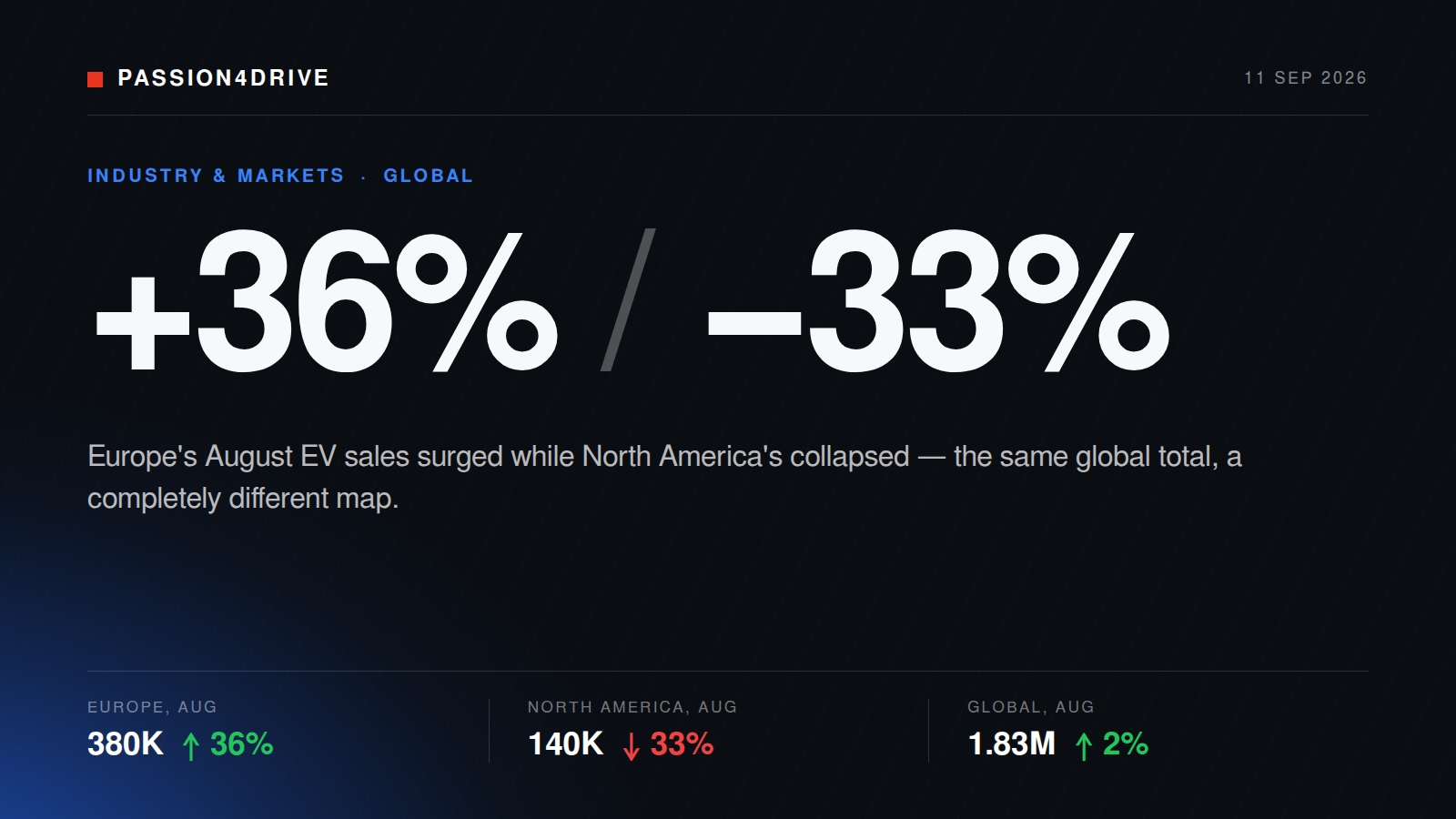
Underneath it, the map has been redrawn. Europe sold 380,000 EVs, up 36%. North America sold 140,000, down 33%. Two markets of broadly comparable wealth and vehicle parc, moving in opposite directions at roughly the same speed, in the same month.
The August Numbers
Benchmark Mineral Intelligence's monthly dataset, reported by Reuters on 11 September, puts the regional split like this:
- Europe — 380,000 units, +36% YoY. Year-to-date: 3.3 million, up 29%.
- China — 1.03 million units, -11% YoY. Year-to-date: 6.9 million, down 12%. Battery-electric sales alone edged up 0.8%.
- North America — 140,000 units, -33% YoY. Year-to-date: 1.0 million, down 21%.
- Rest of World — 290,000 units, +97% YoY. Year-to-date: 2.0 million, up 97%.
Globally, that is a sixth consecutive month of growth and 13.4 million units year-to-date, up 4%. August volumes were down 1% on July — a normal European summer shutdown effect, not a trend break.
The composition, not the total, is the story. China still supplies more than half of global EV volume, but it is no longer supplying the growth. Europe and the Rest of World bucket are.
Why Europe Is Accelerating
Europe's 36% jump is not a demand miracle. It is policy working as designed, in three layers.
Subsidy re-entry. After a period of withdrawn incentives — the German purchase-bonus collapse being the most damaging example — several major markets have put money back on the table. Spain's Auto+ programme offers up to €4,500 per electric vehicle. France's leasing-led schemes have pushed battery-electric share to a record: Automotive News Europe reported French BEV share at roughly 38% in August, close to double the year-earlier level.
CO2 compliance mathematics. European manufacturers are managing to fleet-average emissions targets. When compliance is priced in euros per gram, selling an EV at thin margin is cheaper than paying the penalty on an ICE unit. That pushes OEMs to discount, allocate supply into Europe, and prioritise electric launches — regardless of whether the consumer asked for it this quarter.
Product finally arriving at price. The small-EV wave — Renault 5, Citroën ë-C3, and the Chinese-built entrants underneath them — has moved the entry point down into territory where EVs compete on monthly payment rather than on ideology.
Europe did not out-innovate North America in August. It simply kept paying for the transition while North America stopped.
Why North America Collapsed
The North American figure looks like a market failure. It is closer to an accounting artefact with a real hangover attached.
The US federal EV tax credit expired on 30 September 2025. The quarters immediately before that deadline pulled an enormous volume of demand forward — buyers who would otherwise have purchased in 2026 bought in 2025 to capture the credit. August 2026 is being measured against that inflated base, which is why the year-on-year print is as ugly as -33%.
But the year-to-date figure — 1.0 million units, down 21% — tells you this is not purely a base effect. Without the credit:
- EVs lost roughly $7,500 of effective price competitiveness overnight against comparable ICE and hybrid product.
- OEMs have responded by delaying EV programmes and re-weighting toward hybrids, which reduces future showroom availability, not just current demand.
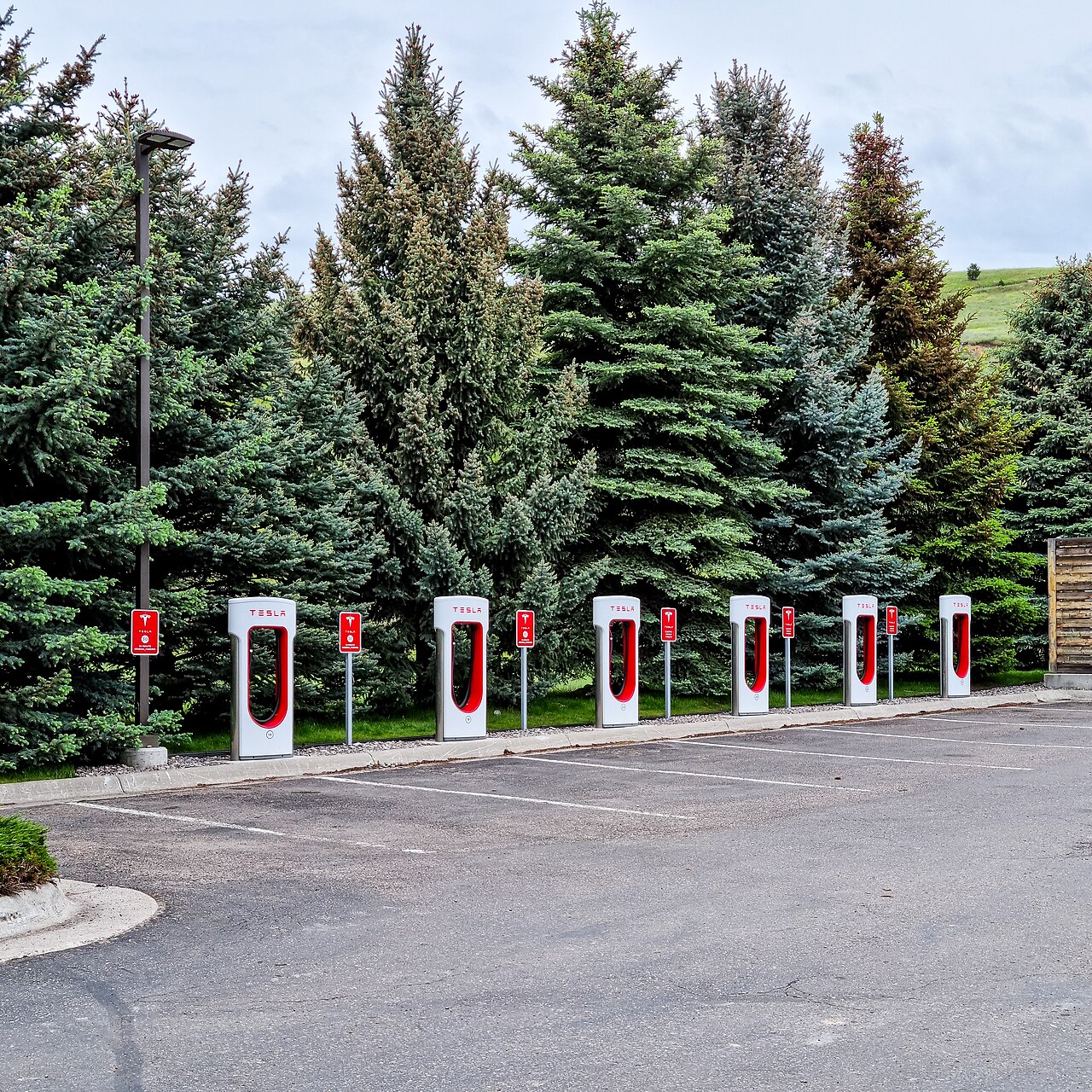
- Charging build-out economics weaken as utilisation forecasts fall, which feeds back into consumer hesitancy.
That is a structural loop, not a timing blip. North America is now the only major region where the electric share of the market is going backwards.
China's Two-Speed Print
China's -11% needs reading carefully, and it connects directly to the export figures we covered earlier this week. Domestic retail is contracting under the withdrawal of trade-in subsidies and brutal price competition, yet battery-electric sales still rose 0.8% — the decline is concentrated in plug-in hybrids and extended-range vehicles.
Meanwhile Chinese EV exports rose more than 150% year on year to roughly 518,000 units in August. Chinese manufacturers are not losing volume. They are relocating it.
That is the mechanism connecting the two halves of this dataset: a large share of Europe's 36% growth is being supplied, directly or through European-badged partnerships, by Chinese production capacity that can no longer be absorbed at home.
What This Means Commercially
For anyone allocating capital, marketing budget or supply against the EV transition, three things follow from August.
One: the growth market is now Europe and the "Rest of World" bucket. That +97% Rest of World number — Southeast Asia, Latin America, the Middle East, India — is the fastest-compounding line in the dataset, from a small base. It is also the market Chinese OEMs are targeting hardest with the volume they cannot sell domestically.
Two: North America is a policy-dependent market that lost its policy. Any 2027 planning assumption built on US EV volume recovering to 2025 levels needs an explicit trigger — a new federal or state incentive structure — rather than an assumption of natural recovery.
Three: subsidy-backed growth is borrowed growth. Europe's 36% rests on schemes that have been switched off before and can be switched off again. Spain's Auto+ and France's leasing social have defined budgets. The question for 2027 is not whether European EV demand is real, but what share of it survives the next fiscal consolidation.
What to Watch Next
- September European registrations, which will show whether August's surge survives the return from summer shutdown or was partly a pull-forward of its own.
- Whether any US federal or state incentive replacement gains traction, and how quickly OEMs would re-accelerate delayed programmes if one did.
- The Rest of World run rate, and whether it holds near 290,000 units a month — the single clearest indicator of how fast Chinese export capacity is finding new homes.
- European trade response, since a growth market increasingly supplied from China is a political problem waiting for a tariff answer.
The global total went up 2% in August. Almost nothing else about the market stayed where it was.