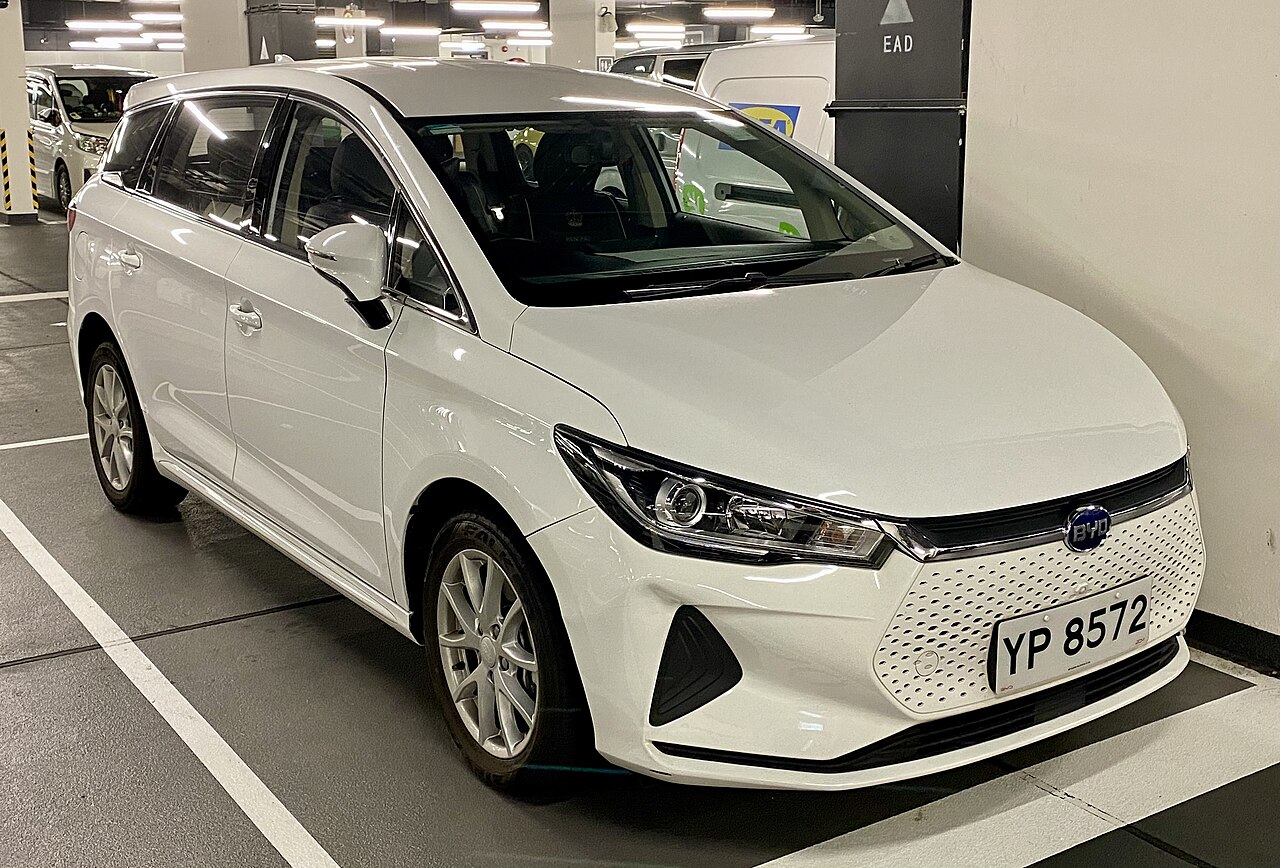
BYD has filed a recall with China's State Administration for Market Regulation covering 183,211 vehicles, built between 27 June 2014 and 14 January 2022. The notice was released on Friday 18 September 2026 and takes effect immediately.
The defective component is a brake pedal stopper pad — a small rubber part that the pedal rests against when it is not being pressed. It is among the cheapest things in the car.
What Is Actually Being Recalled
The recall splits across two of BYD's oldest Dynasty-series nameplates:
- Tang — 142,895 vehicles total, comprising the original Tang (58,026, built 28 March 2015 to 21 December 2018), the all-new-generation Tang DM (77,846, 19 May 2018 to 14 January 2022) and the all-new-generation Tang EV (7,023, 27 December 2018 to 25 October 2021).
- Qin — 40,316 vehicles, built 27 June 2014 to 9 June 2019.
Every affected car is between four and twelve years old. None is in current production.
The Failure Mode Is Not What You Would Guess
A recall involving the word "brake" invites an assumption that braking fails. That is not what is happening here.
According to the filing, manufacturing problems produced material abnormalities in certain batches of stopper pads. Over years of use, those pads crack and degrade. In the worst case they detach entirely — and when the stopper is gone, the pedal no longer returns fully to its rest position, so the brake light switch stays closed.
The result is a car driving down the road with its brake lights permanently illuminated.
The car still stops. What fails is the signal the car sends to everyone behind it. A vehicle whose brake lights are always on is a vehicle whose brake lights convey nothing, and the driver following it loses the single most important piece of information in stop-and-go traffic.
The braking system is intact. What has broken is the car's ability to tell the truth about it — which, in dense traffic, is the same problem wearing a different coat.
BYD will have authorised dealers replace the affected stoppers with improved parts free of charge. Vehicles that already received the improved component do not need a second replacement.
Why the Number Matters More Than the Part
At 183,211 units this is a larger action than the roughly 115,000-vehicle recall BYD filed in October 2025, which was described at the time as the company's biggest. A further action covering around 90,000 plug-in hybrids followed in December 2025.
Three sizeable recalls inside eleven months is a pattern, and it is worth reading correctly rather than dramatically.
The mechanical reading is the boring one and probably the right one: BYD's installed base has grown faster than almost any automaker's in history, and recalls are a lagging function of volume. Cars sold in 2015 through 2022 are now old enough for material fatigue to surface. A company that sold very little a decade ago and enormous quantities since will, mechanically, generate large recall numbers now — on old cars, for problems that take years to appear.
The less comfortable reading sits alongside it rather than replacing it. The affected window is exactly the period when BYD was scaling hardest, and cost discipline on commodity parts is the most obvious place for scale pressure to leave a mark. A stopper pad is not a component anyone specifies carefully when the priority is output.
Both things can be true. Volume explains the magnitude. It does not by itself explain the component.
The Timing Is the Part Worth Watching
This lands in a difficult quarter for BYD's domestic business. Chinese retail volumes have been falling year-on-year for several consecutive months, and the company's growth story through 2026 has rested increasingly on exports rather than the home market — a shift that also showed up in China's August NEV export figures, which ran roughly 130% ahead of the prior year.
That is what makes a recall of this size worth more than a paragraph.
- Domestically, the reputational cost is low. SAMR filings are routine, the remedy is free, and Chinese buyers are not currently choosing between BYD and a brand with a spotless recall ledger.
- Externally, the ledger is the product. In Europe, in Southeast Asia, in Australia and increasingly in Latin America, BYD is selling against incumbents whose main remaining advantage is a century of assumed reliability. Recall counts are the cheapest available proxy for that assumption — and the least fair one, because they measure disclosure as much as defect.
- The regulatory read-across is real. European and Australian regulators watch SAMR filings. A defect disclosed in China on cars never sold abroad still shapes how closely the next BYD submission is examined.
None of that makes this a crisis. It makes it a data point in the only argument that still matters for Chinese automakers abroad: whether they are cheap because they are efficient, or cheap because something was left out.
What to Watch
Three things will tell you which reading was right:
- Whether the affected component appears in export-market vehicles. So far the filing is domestic and covers cars from a period when BYD's overseas volumes were negligible. If an equivalent notice surfaces in a European or ASEAN market, the story changes shape.
- Whether the next recall is on a newer build window. Old-car recalls are a volume artefact. A recall on 2024-2026 production would be a quality signal.
- Whether BYD says anything beyond the filing. The company has not made this a public communication event. For a brand whose export case rests on being taken seriously as an engineering business, silence is a choice — and eventually a costly one.