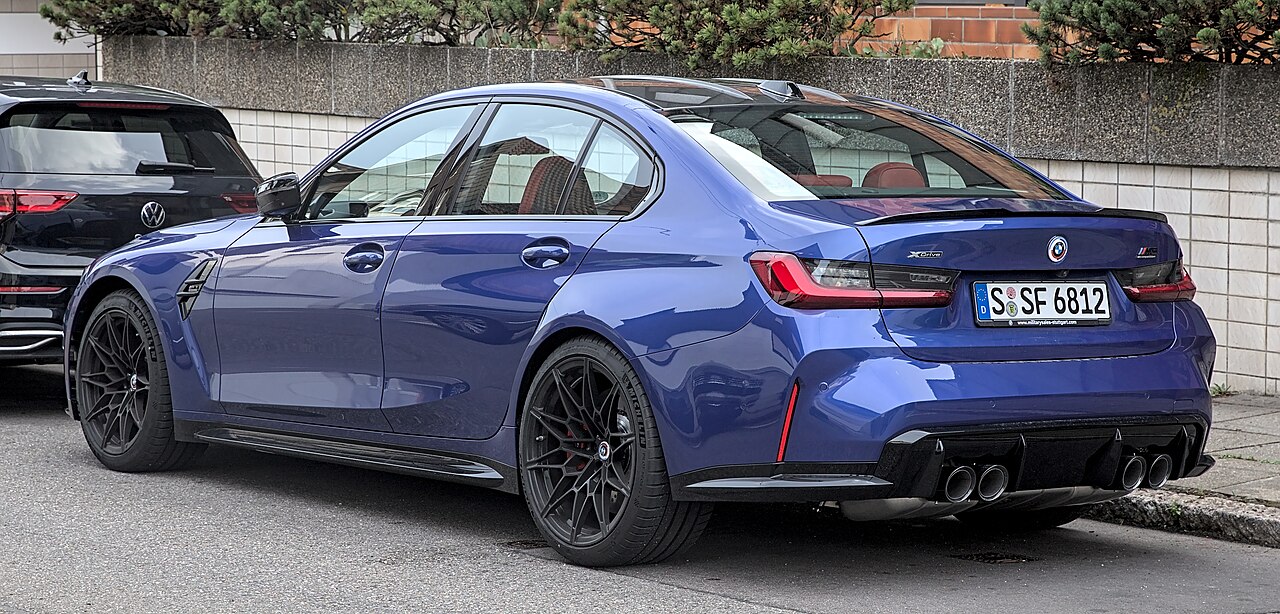
On 2 October 2026, BMW M built its one-millionth car. It is an M3, finished in BMW Individual Fire Orange III, and it came down the line at BMW Group Plant Munich.
The company announced two things on the same day, and the second one matters more than the first. Munich has been confirmed as the production site for the first fully-electric BMW M3 — and from 2027, Munich will build nothing but fully-electric vehicles.
One million M cars, and the factory that made the millionth stops making combustion ones within fifteen months.
The Number Took Five Decades
A million is a modest figure for a mass-market brand and an enormous one for a performance division. BMW M has been selling cars for over five decades; the first M3 reached the market roughly 40 years ago, in 1986. The current generation has been built at Munich since 2020.
For context on the pace: BMW Group as a whole sold 2.46 million passenger cars in 2025 alone. M's entire cumulative output across fifty-odd years is under half of one year's group volume. That is what a performance sub-brand looks like when it has not been diluted into a trim level — and it is also why the division has historically been able to take engineering positions the volume business could not afford.
Franciscus van Meel, chief executive of BMW M GmbH, put the milestone in exactly those terms:
BMW M combines road and racetrack capability with everyday practicality. The one-millionth BMW M vehicle shows that these values are still very much appreciated by our customers, 40 years after the market launch of the first BMW M3.
Munich Is Being Rebuilt, Not Repurposed
The plant decision is the substantive news, and the capital behind it is not small.
- €650 million (about US$761 million) is going into converting Munich for exclusive electric production
- The work includes a new body shop and a new assembly area, together covering roughly one-third of the site
- The plant is more than 100 years old and sits inside the city, hemmed in by Munich itself
- From 2027, it builds only fully-electric vehicles
That last point is the one worth sitting with. BMW's main plant — the one attached to the headquarters, the one in the brand's founding city — is going all-electric on a fixed date, and the company has chosen to put its most emotionally loaded nameplate on that line rather than somewhere safer.
The i3 was the first Neue Klasse model built at Munich. The electric M3 will be the second, and the first high-performance car to use BMW M's Neue Klasse technology.
Munich plant head Peter Weber framed the M3's presence there as continuity rather than disruption: the M3 has close ties to the main plant, and the first fully-electric one will be built in the same place.
What Was Already Known, and What Is New
Passion4Drive reported on 3 September 2026 that BMW M had confirmed a quad-motor powertrain of around 1,340 hp for the first pure-electric M3. That settled the engineering question.
What was missing was everything industrial: where it would be built, what the plant conversion would cost, and whether the combustion M3 and the electric one would overlap on the same line for a transition period.
This announcement answers the first two. It leaves the third deliberately open — no production start date for the electric M3 has been given, and BMW has not said when the current combustion M3 leaves Munich. Those two dates have to meet somewhere before the 2027 cutover, and the company is not yet saying where.
Why It Matters
The transition risk has moved from product to plant. A quad-motor electric M3 is a technical bet. Converting the brand's home factory to electric-only by a fixed year is a capital and utilisation bet, and it is far less reversible. If European electric demand in the performance segment disappoints, BMW cannot quietly extend combustion production at Munich — the body shop will not be there.
It is a markedly different posture from the American market. In the same week, General Motors reported US electric volume down 61.7% year on year. BMW is pouring €650 million into making its most symbolically important plant electric-only. Both companies are reading their own markets, and the divergence between European and North American EV trajectories is now showing up in where the concrete is being poured.
The M badge is being used as the proof point. Putting the electric M3 at Munich, announced alongside the one-millionth M car, is a communications decision as much as a logistics one. BMW is betting that the customers who bought those million cars will follow the badge rather than the engine. That is the assumption the next five years will test — and unlike a powertrain specification, it cannot be revised in a press release.