Argentina's RIGI regime has approved 23 projects worth USD 53.382 billion since it was created. Until last week, not one of them was a car plant.
On 30 September 2026, the regime's Evaluation Committee admitted Toyota Argentina and a USD 1.341 billion investment at Zárate, in Buenos Aires province. Economy Minister Luis Caputo called it the largest investment in the history of the country's automotive industry. Toyota's own language was more careful: RIGI entry, the company said, "allows advancement in Toyota's final approval process."
That gap between the minister's superlative and the manufacturer's conditional is the most useful thing in the announcement.
What Is Actually Being Built
Zárate is not a greenfield. Toyota has built there since 1997, and the plant currently turns out the Hilux pickup, the SW4 SUV and the Hiace van. The new money upgrades that site to add an electrified vehicle Argentina does not currently make.
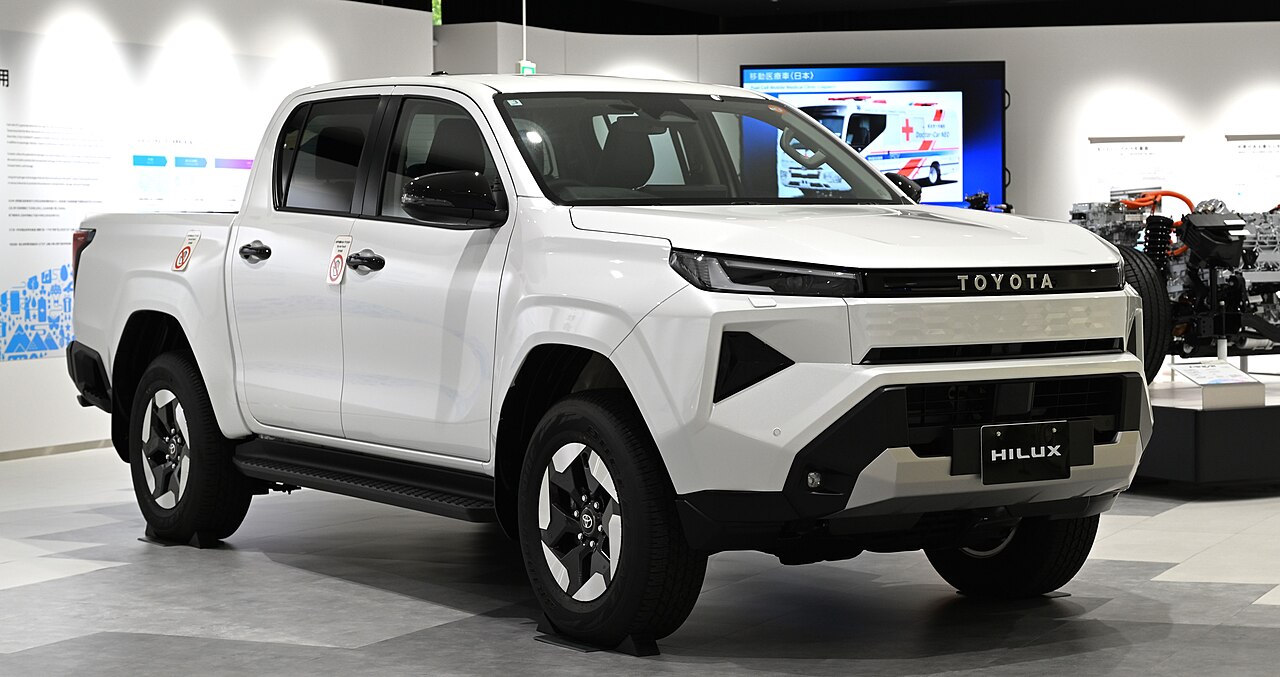
The vehicle has not been formally named by Toyota. The Argentine government's own account describes a fully electric Hilux with a specific and unusually detailed powertrain: two motors, 196 CV, 470 Nm, a 59.2 kWh lithium battery, roughly 300 km of range and permanent all-wheel drive. Independent coverage reaches the same conclusion — an all-electric Hilux — while noting Toyota has said it will confirm specifics later.
Read those numbers as a product decision rather than a spec sheet. A 59.2 kWh pack and 300 km of claimed range is not a long-haul pickup. It is a work vehicle sized for a market where charging infrastructure is thin and price sensitivity is total. Toyota has not tried to build a Cybertruck for Latin America. It has built the cheapest credible electric Hilux it can, and it is building it where the Hilux already has thirty years of supply chain behind it.
The Export Number Is the Business Case
The domestic Argentine market is not what justifies USD 1.341 billion.
- Projected annual exports: USD 1.280 billion
- Share of production destined for foreign markets: roughly 70%
- Jobs: 3,600+ during construction, around 2,600 in operation
An export-weighted plant at that ratio is a regional play. Zárate becomes Toyota's electric-pickup source for Latin America, with Argentina taking the smaller domestic slice and the incentive regime carrying the cost of capital.
Seventy percent of output leaving the country is the whole argument. This is not Toyota betting on Argentine EV demand. It is Toyota using Argentine industrial policy to buy a position in a market it is currently losing.
Who It Is Aimed At
BYD accounted for close to 60% of electric-vehicle sales in Latin America through July 2026.
That is the number Toyota is responding to. Chinese manufacturers entered the region the way they entered Europe — imported, cheap, and faster to market than anyone expected. The defence available to an incumbent is not price. It is local content, local assembly, and the tariff and logistics arithmetic that comes with building inside the bloc rather than shipping into it.
Toyota has the advantage here that it did not have in Europe: it is already the incumbent in the segment. The Hilux is not a product Toyota has to introduce to Latin American buyers. It is a product it has to electrify before someone else offers an electric equivalent at a price Toyota cannot match from outside the region.
The risk is the timing. Toyota has not published a start-of-production date. A plant upgrade of this scale is a three-to-four-year project on normal timelines, which means the electric Hilux arrives into a market where Chinese competitors will have had several more model cycles to establish themselves. Industrial policy moves at the speed of committees; Chinese product cycles do not.
What RIGI Actually Does — And What It Signals
RIGI is Argentina's large-investment incentive regime, offering tax, customs and foreign-exchange stability guarantees to projects above a threshold in exchange for committed capital. Its first twenty-two approvals skewed toward extractive and energy projects. Toyota is the first carmaker through.
For Argentina, that is the point of the announcement: proof that the regime can attract manufacturing, not just mining and hydrocarbons. For the rest of the industry, the read-across is more interesting. Stellantis, Volkswagen, Renault, Nissan and Ford all have Argentine plants. A precedent now exists for how a manufacturer gets large-scale electrification capital into the country on terms it can underwrite.
Expect the file to be reopened by others. The first application through a new regime is always the expensive one to prepare; the second is a template.
Why It Matters
Three things are worth holding onto.
- The approval is real; the car is not yet committed. Toyota's phrasing — RIGI entry "allows advancement in Toyota's final approval process" — means the internal investment decision is still in train. The government has approved the incentives. The board has not finally approved the plant.
- This is a defensive capital allocation, and it is being read as a growth one. Toyota is spending USD 1.341 billion to protect a segment it already owns against a competitor that owns the adjacent one. That is a rational use of money. It is not the same thing as an expansion.
- Industrial policy is now the main instrument of EV localisation outside China. The US has the Inflation Reduction Act's successor arrangements, Europe has its own local-content debate, and Argentina has RIGI. In every case the mechanism is the same: make building locally cheaper than importing, and let the tariff maths do the rest.
Toyota did not choose Zárate because Argentina is the best place in the world to build an electric pickup. It chose Zárate because it already builds pickups there, and because Argentina was willing to pay part of the bill.