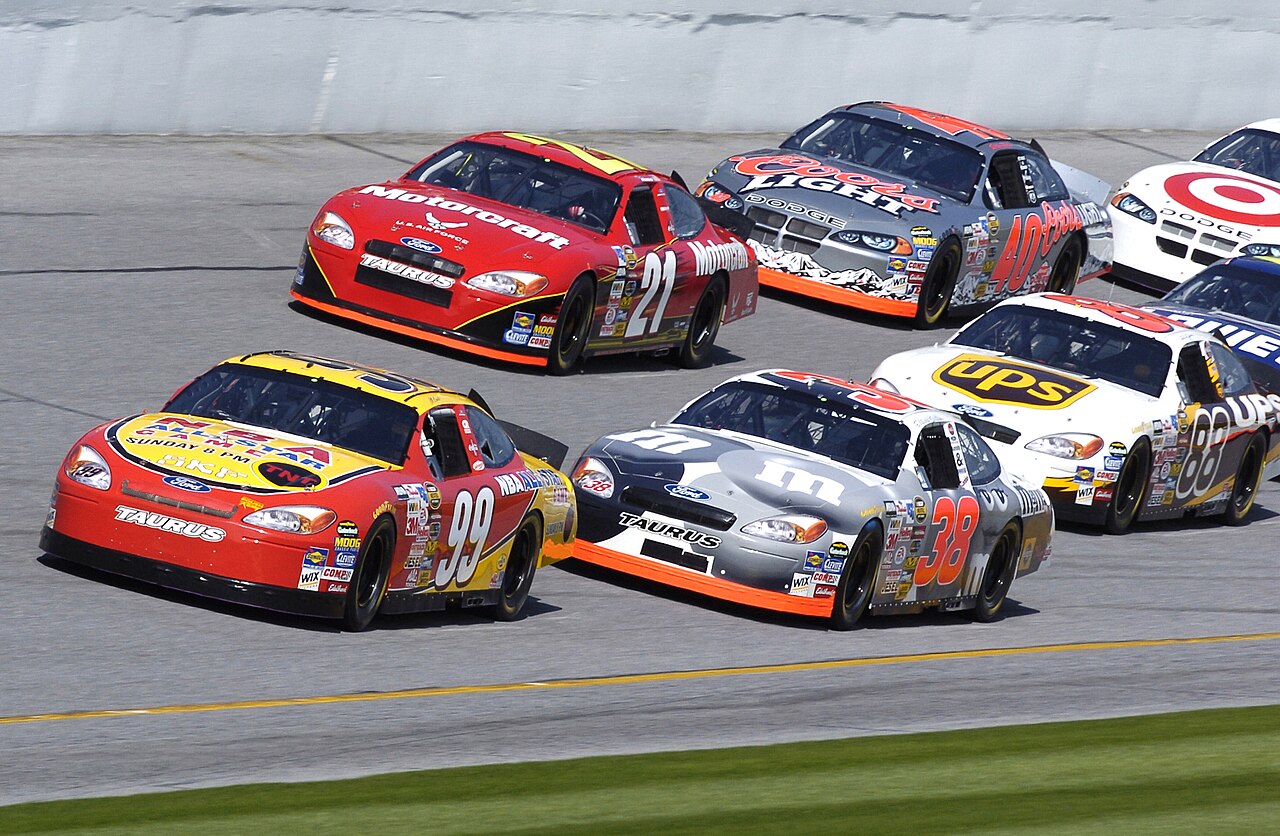
Kyle Larson won the Enjoy Illinois 300 at World Wide Technology Raceway on Sunday, 13 September, ending a 51-race winless drought that stretched back to Kansas Speedway on 11 May 2025. It was his 33rd career Cup victory and his first at the Madison, Illinois oval.
That is the clean sentence. Almost nothing else about the afternoon was clean.
The Race Nobody Controlled
The Enjoy Illinois 300 was scheduled for 240 laps around the 1.25-mile Gateway oval. It finished on lap 247, after two overtime restarts, with 18 caution periods consuming 87 laps — a track record, and the most yellow-flag laps of the 2026 Cup season.
Put that in proportion. More than a third of the race distance was run under caution. On a 1.25-mile track where track position is difficult to recover and pit strategy is compressed into short green-flag windows, 18 restarts is not a race so much as a series of eighteen short races with an ever-shrinking field of healthy cars.
Joey Logano led a race-high 96 laps and took Stage 1. Larson led 80 and took Stage 2. Between them they controlled roughly 70% of the distance, and neither had anything resembling a comfortable afternoon.
The attrition was not ordinary short-track contact. Several Chase contenders suffered brake rotor failures — the mechanical signature of a flat, heavy, repeatedly-restarted oval race where cars spend the entire day hauling down from speed into Turn 1 without the cooling relief of sustained green-flag running. Zane Smith found the Turn 1 barrier late in Stage 2. Ty Gibbs made contact with Erik Jones early. Riley Herbst and Shane van Gisbergen were collected in a multi-car incident. Chase Elliott and Bubba Wallace both took late damage.
Eighteen cautions does not produce a fluke winner. It produces a winner who was fast, and then survived being fast eighteen separate times.
Larson's 51 Races
The drought number deserves a moment, because the instinct is to read it as a slump. It was not.
Larson's 51 races without a win covered a period in which he remained a regular front-runner — a driver leading laps, winning stages, and putting the No. 5 in position most weekends without converting. The gap between "fastest car" and "car in victory lane" is where modern Cup racing actually lives, and Larson said as much afterwards.
"It takes a lot more than just having the fastest car to win a Cup Series race. You still have to execute."
He also gave the credit where a 16-month wait tends to test a team hardest:
"Just proud of my team for working so hard, being so patient through all the tough times."
That is the operational read. Nothing structural was broken at Hendrick's No. 5. What was missing was the last five per cent — restart execution, caution-cycle timing, and the luck to be on the right side of a yellow flag. On Sunday, in the race with the most yellow flags of the year, that finally broke his way.
Alex Bowman finished second, making it a Hendrick Motorsports 1-2. Logano completed the podium in third, with William Byron fourth and Ross Chastain fifth.
| Pos | Driver | Note |
|---|---|---|
| 1 | Kyle Larson | No. 5 Hendrick Chevrolet — led 80 laps, won Stage 2 |
| 2 | Alex Bowman | No. 48 Hendrick Chevrolet — completes the 1-2 |
| 3 | Joey Logano | No. 22 Team Penske Ford — led a race-high 96, won Stage 1 |
| 4 | William Byron | Third Hendrick car inside the top four |
| 5 | Ross Chastain | Ran up front through the caution cycles |
| 6 | Austin Dillon | |
| 7 | Connor Zilisch | |
| 8 | Carson Hocevar | |
| 9 | Denny Hamlin | Retains the Chase points lead |
| 10 | Austin Cindric |
Three Hendrick Cars in the Top Four
The line that will get repeated in the garage this week is not Larson's drought. It is that Hendrick Motorsports put three cars in the top four on a day when a third of the field was dealing with brake failures, damage, or both.
That is a car-preparation result as much as a driver result. Gateway punishes braking hardware, and an 87-lap caution total multiplies the punishment — repeated cold-hot cycling on rotors that were specified for a race with far more sustained green running. Teams that guessed conservatively on brake package survived. Teams that optimised for outright pace paid for it.
For a Chevrolet camp that has spent 2026 watching Toyota's Joe Gibbs Racing operation set the championship pace, a 1-2-4 in a Chase race is the clearest signal yet that the equipment gap has closed at the exact moment it matters.
What It Does to the Chase
The standings are where this result actually lands.
- Denny Hamlin holds the Chase lead after finishing ninth.
- Kyle Larson moves up to second, nine points back — a jump from seventh before the race.
- Christopher Bell drops to third, 18 points behind Hamlin.
- Joey Logano sits seventh, 51 points adrift, despite leading more laps than anyone and scoring heavily in stage points.
Two things follow from that. First, a win converts a mid-pack Chase driver into a title contender in a single afternoon — Larson's seventh-to-second move is the whole argument for NASCAR's elimination format in one data point. Second, Logano's position is the counter-argument: the fastest car of the day sits 51 points back and is no better off for it.
Hamlin's nine-point cushion is now the thinnest kind of lead — large enough to matter in a clean race, irrelevant in another Gateway.
Why It Matters Beyond Sunday
Two takeaways worth carrying forward.
The brake-rotor cluster is a specification story, not a bad-luck story. When multiple teams suffer the same component failure in the same race, the variable is the race format, not the workmanship. An 18-caution race creates a thermal duty cycle nobody tests for. Expect Cup teams to bring more conservative brake packages to every remaining flat-oval Chase race, and expect that conservatism to cost them raw pace.
Drought numbers are lagging indicators. Larson's 51 races told you very little about the speed of the No. 5. It told you about conversion. The teams worth watching in the remaining Chase rounds are the ones leading laps without winning — because the gap between those two states closes suddenly, and usually on the most chaotic afternoon of the year.
Larson has 33 Cup wins. The 34th will not require anything like this much survival.